
Robyn Phelan

Published on December 18 | Interview by Romina Provenzi | 5 min read
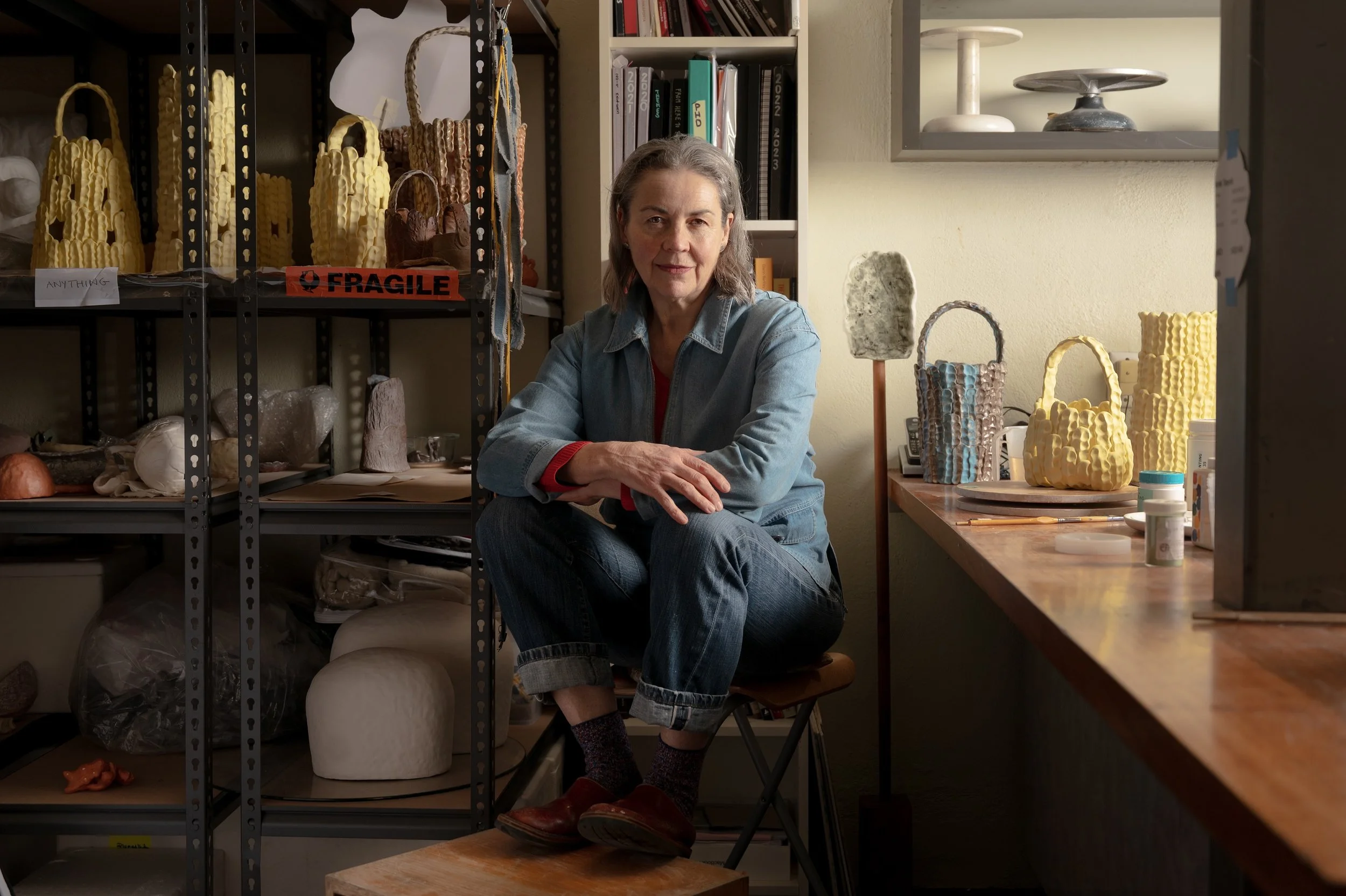
Robyn Phelan's portrait in her studio in Melbourne. Photo by Leni Ciuro Photography
https://robynphelan.com.au/ - https://www.instagram.com/robynphelan/
Robyn Phelan is a Melbourne-based ceramic artist, educator, and visual art curator specialising in contemporary ceramics and site-specific work. Phelan holds both a Bachelor of Fine Arts (Ceramics) with first-class honours (2010) and a PhD (2024) from RMIT University in Melbourne. Her doctoral research, "Compressing Atmosphere: Ceramic Encounters With Clay, Body and Site," examines the creative relationship with clay material and cultural connection to ceramics in Australia. She recently attended the 2025 Australian Ceramic Triennial in Perth, Australia, where she presented her collaborative project, ‘The Elsewhere Project: a Correspondence’.
Interview with Robyn Phelan: Australian Ceramic Artist on Environmental and Collaborative Practice
Nature and Environment in Ceramic Art Practice
How do nature and the environment come into play in your work?
The connection between clay and the environment has been central to my art practice from the start. I’m fascinated by materials that respond and carry the history of touch, which is why I use clay to record my work in the environment for my projects. When I started ceramics, I was raising two boys who were out and about, living in an inner-city apartment in North Melbourne, with no studio. During the holidays, I would go bush with the boys and make art while camping, as I couldn't make clay at home without the children getting involved. This helped me see my body’s interdependence with the clay and the site where I create my work. In 2020, it marked a significant milestone in my career when I began a PhD at RMIT University, the Royal Melbourne Institute of Technology. But I found myself with no studio, no clay, and no possibilities of working on a rural site because Melbourne was in lockdown due to the pandemic outbreak for two years. Suddenly, my son was sent back to Australia from a student exchange in the States, with the obligation to quarantine with a parent. I picked him up at the airport, bringing with me all the clay I had left, and taking the opportunity to work through the quarantine. Actually, this made me realise that the site didn't need to be a rural natural one, and for just about a year, I've had a studio.
The Elsewhere Project: Long-Distance Artistic Collaboration
The ‘Elsewhere Project: a Correspondence’ is about the environment and a long-distance collaboration. Can you talk about it?
After earning my PhD, I realised that no one is working like me here, as Melbourne is more design-oriented than a contemporary art hub, and I needed to find my buddies. In 2022, I attended an online workshop organised by A-B Projects with British artist Sarah Christie, ‘Correspondence’. It made me think about collaborating, so I emailed her about working together on a project at a distance to present at the 2025 Australian Ceramics Triennial in Fremantle, Perth, Western Australia. We agreed to work on this project for eleven months and rolled through, starting with an exchange of words based on the books we're reading. I was reading ‘The Old Ways: A Journey on Foot’ by Robert Macfarlane, a British writer and Fellow of Emmanuel College, Cambridge, while Sarah was reading ‘Praiseworthy’ by Australian writer Alexis Wright. Basically, we exchanged five sets of words at the same time, sending them by post, waiting till they were received and then the correspondence was returned without clay, which only came into the project when Sarah travelled to Australia in September 2025 to work with me on site and attend the Australian Ceramics Triennial together. I took her to my favourite rivers, and we became aware of walking with the river’s flow, so your body flows with the water, and the ideas flow too. We took clay with us and decided spontaneously where to make an impression of the site and impressed it into trees. Then we brought those impressions back to the studio, carefully peeled them off, and built a sculpture from those points, like a correspondence.
Inclusivity in the Australian Art World
How inclusive is the art world, in reference to the Australian art world?
Certainly, if I were able to survey who was exhibiting or being collected right now, males would be predominant. But there's been a jump in inclusivity for women, for the benefit of LGBTI, for people of colour, for First Nations people, which is great, although often they are male. Institutions are trying to check boxes and fill gaps. For example, I started as an artist in my 40s, after decades of working in curatorial, writing and teaching ceramics. Therefore, I hadn’t exhibited my work much, and there is the problem of not fitting into any categories when I'm applying for grants, because clearly, I am not an emerging artist. Thankfully, through my PhD research, I can take control of the type of work and projects that I want to do, like the 'Elsewhere Project’ with Sarah Christie, and my new project ‘Benevolent Clay’. This latest one is inspired by the Melbourne Benevolent Asylum, founded in 1850 in North Melbourne to care for the poor, sick, and homeless who voluntarily moved in during the population boom following the gold rush. In 1910, when the building was demolished, I was asked by the council, as a member of the local historical society, to propose a name for a lane that runs through the middle of the former asylum building. This is now called Anastasia Lane in honour of Anastasia Leahy, a completely blind woman of Irish descent, like me, who entered the asylum at 19 years old, and stayed there her whole life. For my project, I was able to get clay from the foundations on the same footprint that Anastasia would have walked. As I live a hundred metres from there, this clay has taken the impression of her feet and mine, too, as we’ve both walked the same street. I'm planning to interview Irish migrants from the suburbs and collect their stories, and make clay objects with them. It's really what interdependence is about.
Reflections on this interview
There's something deeply moving about an artist who discovers her practice through limitations. Pandemic lockdown and a quarantine hotel room taught Phelan that clay doesn't need wilderness to hold meaning but presence, touch, and relationship. Walking the same ground as Anastasia Leahy, a blind Irish woman who spent her life in Melbourne's Benevolent Asylum, the artist understands something profound about connection across time through materials. Both their feet have walked on the same place, a century apart but recorded in clay. This is why interdependence isn’t seen as a concept, but as a lived experience. She lets the clay record what matters: the river's flow, a tree's impression, the weight of feet on familiar ground, hands shaping something together.
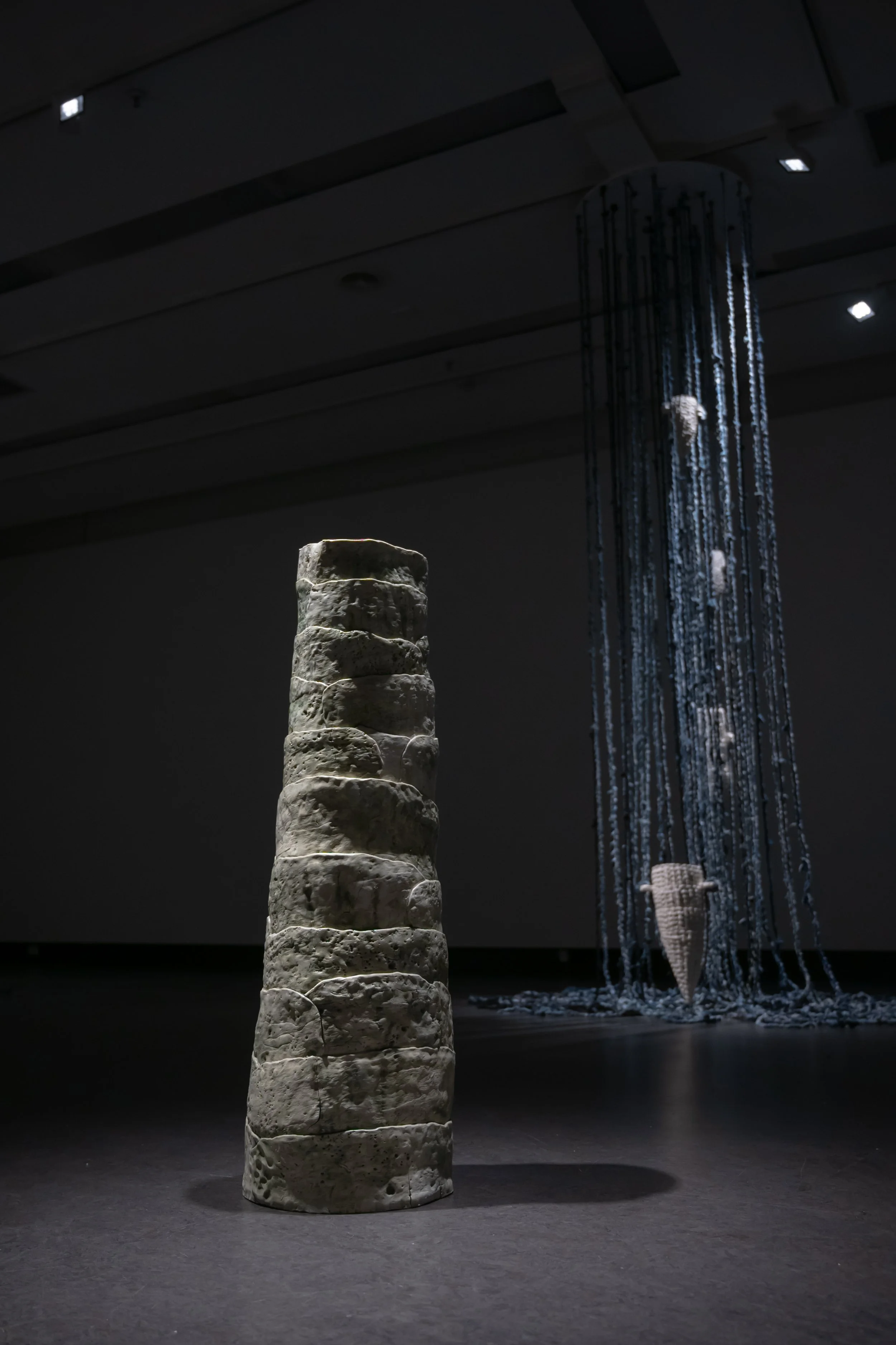
Compressing Atmospheres (installation view), 2024, SITE 8, School of Art, RMIT University.
Photo by Leni Ciuro Photography
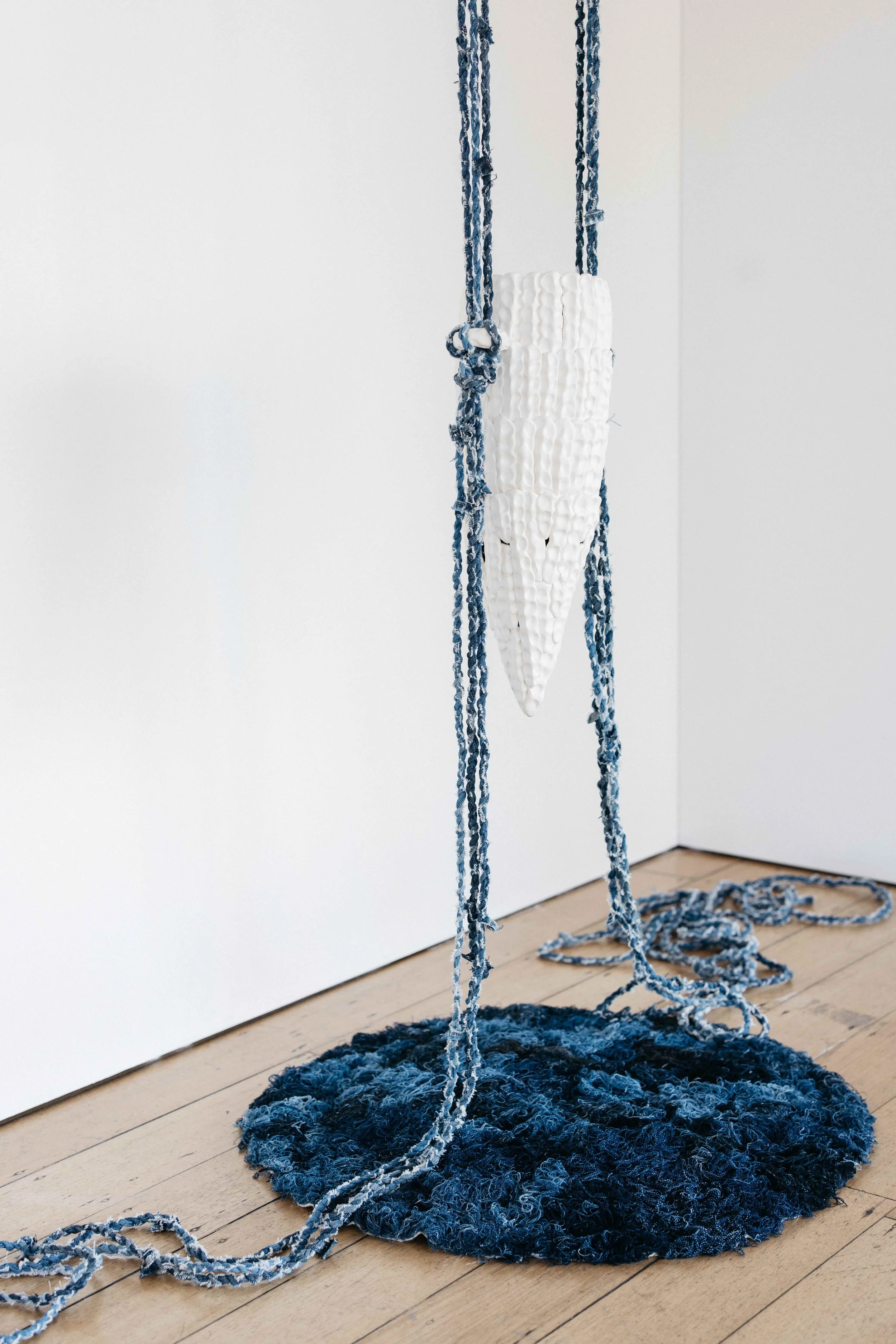
'The Weight of Waiting', 2023, hand-formed clay, terra sigillata, upcycle denim jean felting and twining.
Photo by Marie-Luise Skibbe Photography
If you enjoyed this conversation, please browse through other interviews:
American artist Teresita Fernandez is not interested in illustrating her identity’ in Elephant magazine
Japanese artist ‘Yoshitomo Nara : lessons with clay’ in Elephant magazine
“an espresso with…” series of interviews with female artists, curators and arts professionals
Explore more interviews and reviews in my Portfolio, or subscribe for free to receive new interviews
