
Carolyn Mendelsohn

Published on February 4 | Interview by Romina Provenzi | 5 min read
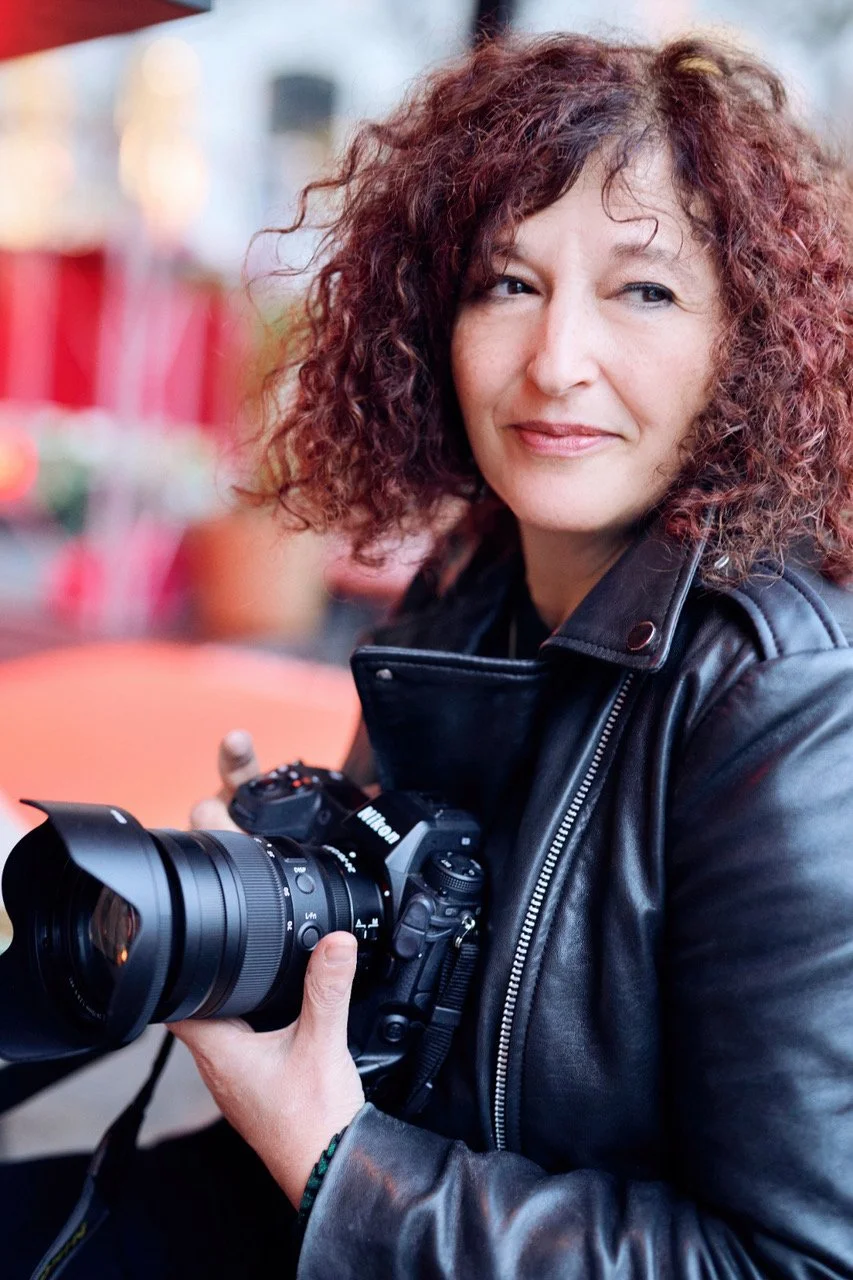
Carolyn Mendelsohn portrait taken by Scarlet Page (C) @carolynmendelsohn_
Carolyn Mendelsohn is an artist and filmmaker based in Bradford, UK. In 2018, she was shortlisted for the International Women Photographers Award and nominated for the RPS 100 Heroines. In 2020, she was the winner of the Portrait Series category for the 15th Julia Margaret Cameron Award and was a winner of the Single Image Award for Open Wall Arles by the British Journal of Photography and Galerie Huit. Carolyn is a Nikon Europe Ambassador and the first Royal Photographic Society Ambassador.
Interview with Carolyn Mendelsohn: artist on collaborative storytelling and photography
Building an Arts Career Beyond London
How do you feel about London as the place to be if you work in the arts?
I think that London being the place to be if you are in the art world isn’t a reality, but a myth, because we communicate and can network with lots of people online, and it doesn't matter where they are based. In fact, many artists who work successfully aren't based in London nowadays. Recently, I was invited to show my work in the exhibition Coming of Age at the Wellcome Trust in London, which will open in March this year, and living in Bradford for twenty years proved no barrier to this opportunity. The works included in the upcoming exhibition are part of my project as an artist in residence for Born in Bradford, a leading health research programme that was started fourteen years ago, tracking the lives of Bradfordians. For the project, once a year, I meet twenty-five young Bradfordians since they were twelve years old, and create their individual photographic portraits. In the exhibition, the work of artists will be displayed alongside the work of scientists, and I really love that collaboration. We should be looking beyond the metropolitan centres, considering that it doesn't really make any difference in terms of being commissioned and being able to do your work.
Creating Space for Voices
What’s at the core of your projects?
I'm interested in people having a space to be, to exist, to breathe, and to speak. People know me for my six-year-long project ‘Being in Between’, based on making portraits of girls from ten to twelve years old. I wanted to give those girls the opportunity to be presented as they truly are, so I organised each portrait sitting with them, asking them about their lives, and letting them choose what they wanted to wear for the portrait. I have a memory of feeling uncomfortable at their age, and I was curious about why I was feeling certain things about myself, which weren't based on truth but on things that happened or been said to me. The project grew, got recognition, was exhibited numerous times, and won some awards. Then I made the work ‘Through our Lens’ to enable young people to tell their own experiences of the pandemic, which weren't included in the visual narrative, working with 100 young people aged 12 to 19. The work was well received, exhibited in galleries including the Impressions Gallery in Bradford, and it’s now archived at the Bradford Museums and Galleries. In 2023, I won a commission with the Brontë Parsonage Museum to work on the project ‘Hardy and Free’ to tell the stories of women in landscape using photography and sound. Based on Emily Brontë’s famous quote,"I wish I were a girl again, half-savage and hardy, and free” in Wuthering Heights, I went on to these adventures where women will take me to places where they felt ‘hardy and free’ and recorded their stories to make the work that the Brontë Parsonage Museum exhibited for a year. In 2025, I went on to do seven new pieces for the Bradford City of Culture,going on these adventures in the landscape with a very diverse group of women, and the large-scale works have been installed on the side walls of a huge building, bringing the landscape into the heart of the city.
Exploring Human Stories Through Photography
What is the main focus of your art practice?
In my work, I explore people's experiences, tell their stories, and work collaboratively with them through the creative process of photography. My background is in theatre, as I trained as an actor, worked as a director, and made films, lots of film projection and site-specific work. When my life changed, and I stopped working in theatre, I found a way to tell those stories differently, picking up a camera. But the stories have always been about people, place, and community. Although I'm known as a photographer, I think of myself as an artist who uses photography to amplify quieter voices in a multi-layered way, like in my latest piece, Motherhood, commissioned by the charity Maternal Mental Health Alliance. Thanks to a recommendation by the Royal Photographic Society, they contacted me when they were setting up a new campaign about women who experienced mental health challenges that hadn't really been talked about. They didn't know that I had such lived experience myself because I had never talked about it publicly. During my first pregnancy, my partner at that time decided to leave me alone with my newborn son, and I was homeless, too. It was the most traumatic experience of my life. I travelled across the country to make Motherhood, and it was challenging and powerful, but at the same time brilliant and a real collaboration too. My work resonates with my own lived experience.
Reflections on the interview
Carolyn's practice reminds us that the most powerful art often emerges from genuine human connection rather than being physically close to major art institutions, galleries, museums, and cultural centres. Her journey from theatre to photography wasn't about changing mediums; it was about finding new ways to honour the same fundamental commitment: creating space for stories that deserve to be heard. What strikes me most is how she refuses the hierarchy of voices, whether photographing girls navigating adolescence, women finding freedom in landscape, or young people whose pandemic experiences were largely invisible. There's something quietly radical in her insistence that Bradford, not London, is exactly where she needs to be to do this work. In an arts world still oriented around metropolitan centres, Carolyn's career demonstrates that meaningful artistic practice is built on proximity to community, not proximity to power. Her lived experiences, including the profound trauma of early motherhood, don't just inform her work; they create the empathy and understanding that allow her subjects to be truly seen. In every project, she's asking the same essential question: who gets to be visible, and on whose terms?
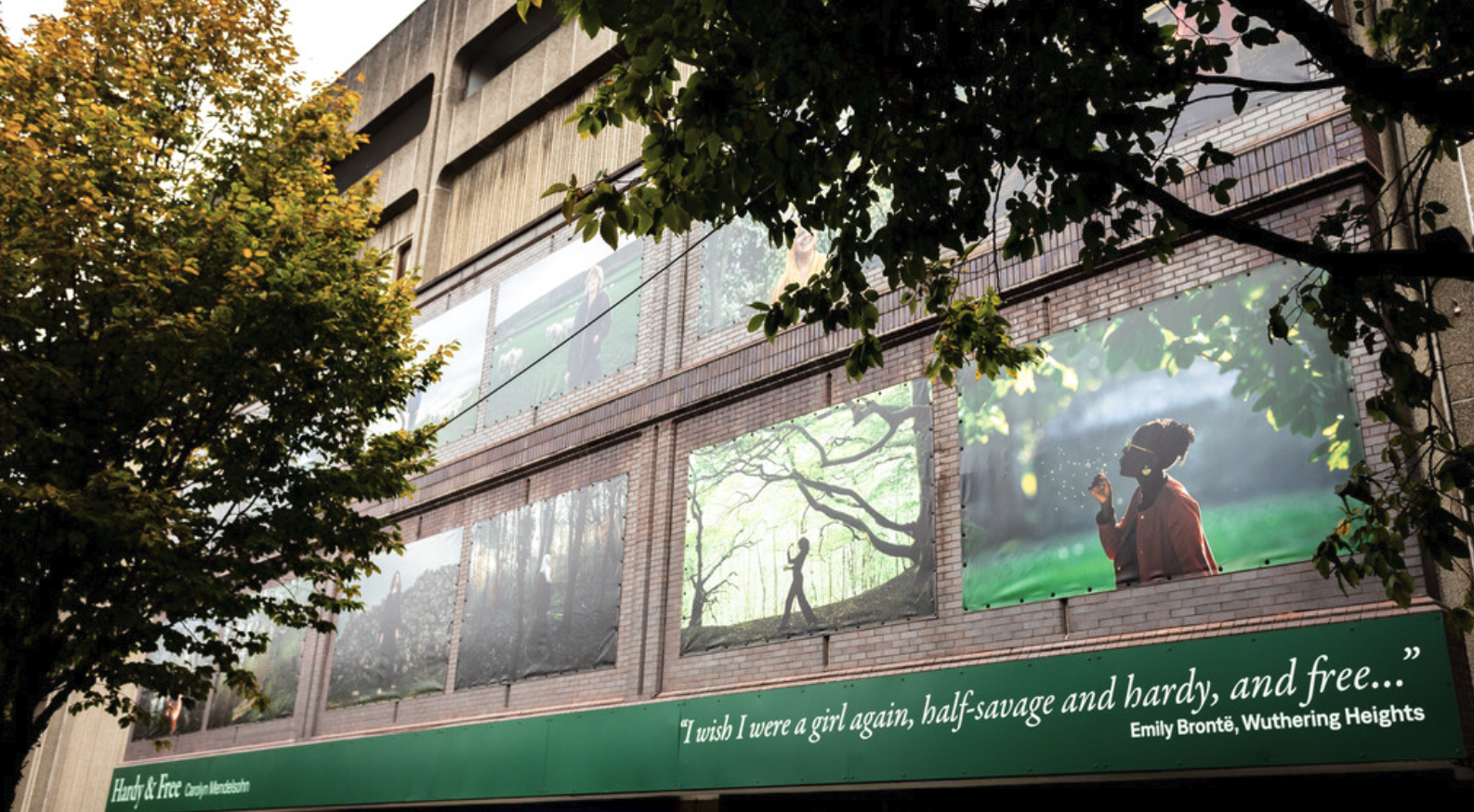
Large-scale photographic installation on building exterior in Bradford city centre, from Carolyn Mendelsohn's expanded 'Hardy and Free' series for Bradford City of Culture 2025

"Women in landscape from Carolyn Mendelsohn's 'Hardy and Free' series for Brontë Parsonage Museum, inspired by Emily Brontë's Wuthering Heights, Bradford City of Culture 2025"
If you enjoyed this conversation, please browse through other interviews:
Interview with artist ‘Rana Begum: Seeking the Essence’ published in Printmaking Today
Interview with artist Bhajan Hunjan, ‘Passion to connect’ published in Sculpture magazine
Interview with artist Emma Talbot, ‘What I create is bound up with being a woman’ published in Wallpaper magazine
“an espresso with…” ongoing series of interviews
Explore more interviews and reviews in my Portfolio, or subscribe for free to receive new interviews

