
Bhajan Hunjan

Published: March 15, 2025 | Interview by Romina Provenzi | 5 min read

Bhajan Hunjan is a London-based artist working with printmaking, painting and drawing, whose practice combines studio work with community engagement and public art projects. With works in the Tate collection and a shortlisting for the Max Mara Prize for Women, Hunjan explores themes of identity, collaboration, and the everyday moments that shape artistic practice. Focusing on printmaking and drawing, Hunjan explores the intersection of professional practice and community participation. Her approach demonstrates how creating art can be both deeply personal and profoundly collaborative. In this conversation, Bhajan discusses what success means beyond commercial recognition, how her practice has evolved from early works now in major collections to more playful explorations, and the importance of community in sustaining creative practice. Below is our conversation part of my series ‘An Espresso with…’.
Interview with Bhajan Hunjan: Artist on Community Art and Identity
Defining Success as an Artist
What does success mean for you as an artist?
Some artists' friends gave up along the way, while others are very much in the limelight, having done brilliantly. In my case, my parents had invested in me, and I was so passionate about being an artist from a young age that it kept that flame of creativity alive as I had to live up to the expectations and endure the ups and downs. My work has always combined studio practice with community work, and it has changed lives along the way. Regarding success, it’s important to share your work out there when you are a maker and to get inspired by other artists and inspire others, as we are all connected like a big spider's web. I am not in this alone because it’s a whole community around you that sustains your practice. Several organisations and people I worked with, including Bow Arts in London, supported my work along the way, which has been the most satisfying part, that other people have been part of my journey. Being shortlisted for the Max Mara Prize for Women and having two of my works included in the exhibition 'Women in Revolt!' at Tate Britain, encouraged me, gave me confidence and helped me to keep going. In the future, if more work goes into public art collections, it would be wonderful. Being a woman and a brown woman, there have always been challenges, but I look at the silver linings within that.
Evolution of Practice and Recent Work
What is the focus of your practice at present compared to your early works?
In the last few years, my early works have been noticed by curators. For example, two of my early works are now part of the Tate collection. Lately, I have been busy archiving my work, which allowed me to look at my whole artistic journey as artists are more prone to reflect on their work’s evolution and progression at a certain age. Now I want to be more playful with my work as I have more time without particular constraints. I have been doing more drawing and basic printmaking based on my dreams of everyday life. The works are based on a gallery of images about what happens in my mind daily. I have also been making simple polystyrene prints similar to those children do at school because it’s a technique with instantaneous results. I added some text and figurative elements to it. It is a new series of work, which I find refreshing and exciting. This is what I have been doing in my studio in London, along with some work on a public art project at its initial stages.
Key Moments in Artistic Journey
Is there a specific moment when things took a good turn in your work?
There have been a lot of moments along the way. It is amazing to see those involved in a public artwork project come around to see it and take photos when it is installed. It is also fantastic to see my work in a magazine and get letters from the participants about socially engaged projects. It has been the little moments along the way, and I cherish each moment as an opportunity, for example, the moments of respect and exchange with those you work with and collaborate with, or to respect and not be hard on yourself. There are always things happening along the way, and you can learn from them because we are not perfect. We are always working on ourselves, as there’s never a moment when you think that you have arrived in life.
Reflections on This Conversation
Speaking with Bhajan revealed how success in contemporary art extends beyond gallery representation to encompass community impact and collaborative relationships. Her journey from having works acquired by Tate to exploring playful printmaking techniques demonstrates the evolving nature of artistic practice. Three key insights: - Success is sustained by community networks and organisational support like Bow Arts - Major institutional recognition (Tate collection, Max Mara shortlist) provides crucial encouragement - Playfulness in technique can coexist with serious artistic inquiry and public art projects.
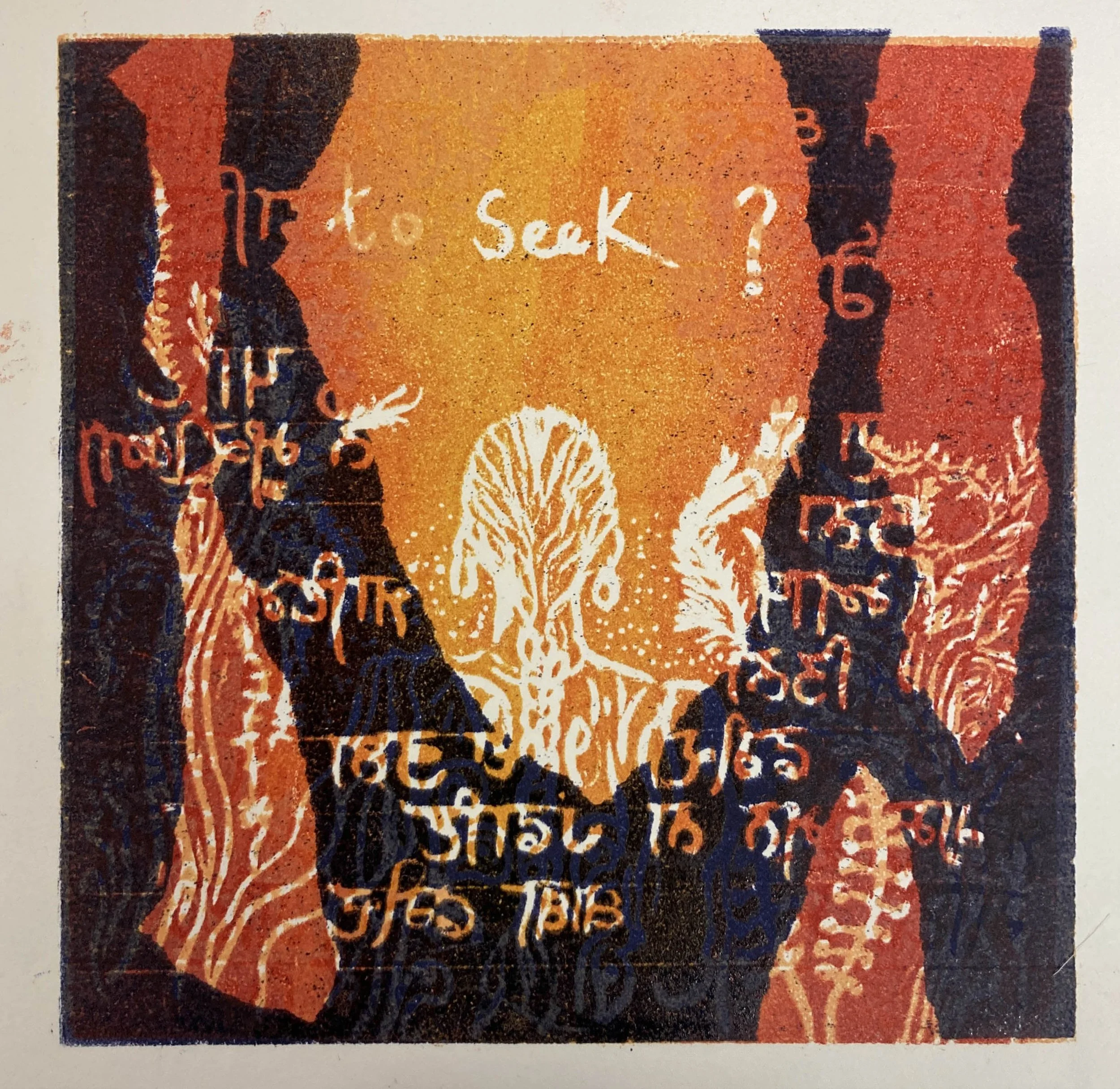
To Seek, monoprint on paper, 20cm sq, 2024
If you enjoyed this conversation, you might also like my interviews with Bhajan Hunjan for Sculpture magazine and for Printmaking Today
More interviews with artists working in printmaking published in Printmaking Today quarterly magazine:
Explore more conversations in my Portfolio or subscribe to receive new interviews from ‘an espresso with…’
